
Warehouse software increasingly supports labels that combine machine-readable codes with color-coded zones, product images, status markers, and safety symbols. This shift reflects a practical need: workers must identify inventory quickly while scanners capture the detailed data stored in barcodes. However, growing software support does not automatically make full-color labeling the best choice for every operation.
For warehouses considering this approach, inkjet barcode labels provide a way to print variable codes, colors, and visual instructions in one production step. The technology can connect label output to inventory, warehouse management, or enterprise resource planning systems. Each label may change according to the item, order, destination, hazard category, or workflow status.
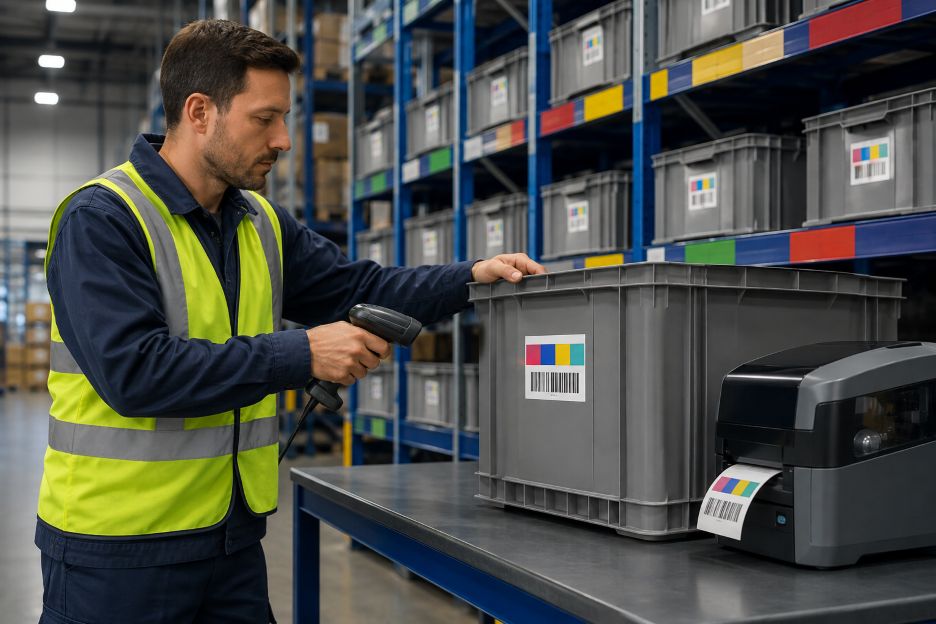
The Problem With Barcode-Only Communication
Traditional monochrome thermal labels are effective because they are fast, familiar, and designed around reliable scanning. A black barcode on a light background remains the safest general configuration. Guidance from GS1 identifies sufficient contrast, suitable bar and background colors, correct construction, and clear quiet zones as central barcode-quality requirements.
Yet a barcode communicates its information primarily through a scanner. A worker looking across a shelf cannot immediately interpret the encoded item number, lot, expiration date, or routing instruction. Text can help, but crowded labels become harder to read. A consistent color block may offer a faster visual cue for stock rotation, quality-control status, destination zone, or product family.
Color should remain a supporting signal rather than the sole source of meaning. Employees may interpret colors differently, while visual impairments and changing warehouse lighting can reduce their usefulness. Important instructions should therefore appear through text, symbols, or software prompts as well. This creates a layered system in which color assists people and the barcode serves scanners.
How Inkjet Technology Bridges the Gap
Color inkjet printing allows software-generated labels to carry variable information and visual elements without relying on preprinted label rolls. A warehouse can maintain a common template while changing the barcode, item description, photograph, colored border, and handling instruction for each record. That flexibility becomes valuable when product ranges, customers, or compliance requirements vary frequently.
Compliance is one of the strongest arguments for color capability. The Occupational Safety and Health Administration explains that shipped hazardous-chemical labels use pictograms with black symbols, white backgrounds, and red diamond-shaped frames. OSHA permits some alternative workplace-labeling systems, but employees must receive the necessary hazard information and training. Color printing can help operations produce these required visual elements alongside tracking data when the application calls for them.
Software integration adds another benefit. Instead of asking employees to choose a label manually, the inventory system can apply a template based on stored attributes. This reflects the broader role of technology tools for workflow automation across modern operations. A returned item might receive one visual treatment, while inspected or quarantined stock receives another. This can reduce dependence on separate stickers, although the result still depends on accurate database records, sensible rules, and disciplined scanning procedures.
Color Must Not Undermine the Barcode
The freedom to add graphics creates a new risk: an attractive label may perform poorly at the scanner. GS1’s 2D barcode implementation guidance warns that graphics, colors, or other visual noise placed in a barcode’s quiet zone can harm performance. Its support guidance also states that black-and-white contrast remains the best option for 2D barcode modules, backgrounds, and quiet zones.
A sound label design therefore separates human-facing color from the scan area. Dark bars or modules should sit on a sufficiently light background, with the required clear space surrounding the symbol. Warehouses should verify labels using the actual printers, materials, scanners, distances, and lighting conditions found in their facilities. A design that scans from a computer screen may behave differently after printing or exposure to moisture, abrasion, chemicals, or sunlight.
Why Monochrome Still Has a Strong Case
Momentum behind color labeling is real, especially where one label must combine inventory identification, branding, warnings, pictures, and workflow cues. On-demand printing also helps organizations avoid keeping multiple versions of preprinted stock. For complex operations, those advantages can justify the additional equipment, ink management, template controls, and testing.
Monochrome thermal output remains practical for high-volume shipping, basic location labels, receipts, and short-life inventory records. These applications may require little more than a barcode, an address, and a few lines of readable text. Adding color could increase operational complexity without improving accuracy or decision-making. Thermal transfer printing can also suit durable identification when the correct ribbon and label material are selected.
A Developing Standard, Not a Universal One
Color barcode labeling is better viewed as an expanding capability than a new universal standard. Inventory software is becoming sophisticated enough to treat labels as visual workflow tools, while inkjet systems make variable color output more accessible. Compliance demands and increasingly detailed product records will continue supporting that direction.
Still, the right standard is the one that matches the task. Warehouses should adopt color when it gives workers meaningful information, supports required graphics, or simplifies several labeling steps. Where speed, simplicity, durability, and scanning reliability dominate, monochrome remains a rational choice. The likely future is a mixed environment, with software selecting the appropriate label format for each inventory process.